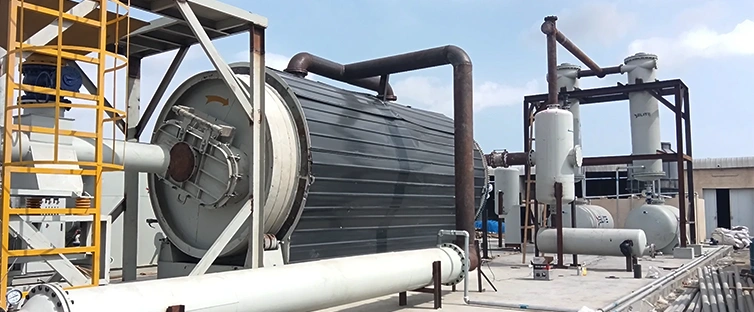
Feedstock flexibility has become a defining performance indicator for contemporary thermal conversion infrastructure. As waste streams diversify and regulatory pressure tightens, a modern pyrolysis plant is expected to process heterogeneous inputs without destabilizing heat balance, residence time, or product quality. This requirement has shifted system design away from narrow, single-material optimization toward broader operational tolerance and adaptive process control.
Material Variability and Thermal Behavior
Different feedstocks exhibit distinct devolatilization profiles, ash content, and calorific dispersion. Mixed plastics, elastomers, oily residues, and composite wastes respond unevenly to identical thermal ramps. A well-engineered plastic to oil plant accounts for these disparities through controlled heating gradients and segmented reaction zones. Rather than forcing uniformity, the system absorbs variability. This approach reduces pre-sorting intensity while preserving predictable hydrocarbon output, an important factor for downstream utilization or refining compatibility.

Pretreatment and Contaminant Management
Feedstock flexibility is not achieved solely inside the reactor. Upstream conditioning plays a decisive role. Moisture, inert solids, and embedded hydrocarbons can suppress thermal efficiency if left unmanaged. Integrating a tdu thermal desorption unit allows volatile fractions to be liberated prior to high-temperature conversion. This staged treatment stabilizes the primary reactor load and mitigates fouling risks. The result is a smoother thermal profile and improved energy recovery across fluctuating input compositions.
Automation as an Equalizer
Operational consistency across variable feedstock categories increasingly depends on automation depth. A fully automatic tyre pyrolysis plant illustrates this principle clearly. Tires differ widely in polymer blend, steel content, and additive chemistry. Automated feeding, temperature modulation, and pressure balancing compensate for these differences in real time. Sensors and closed-loop logic replace manual intervention, reducing process lag and minimizing off-spec byproducts when feed characteristics drift outside nominal ranges.
Continuous Processing Architecture
Batch systems historically tolerated limited feedstock scope due to discrete thermal cycles. In contrast, a continuous pyrolysis machine is structurally predisposed to flexibility. Continuous solids conveyance, steady-state heat input, and uninterrupted vapor extraction dampen the shock effects caused by feed variability. This architecture favors industrial-scale deployment where mixed or inconsistent waste supply is unavoidable. Stability is maintained not by restricting inputs, but by engineering flow paths that accommodate fluctuation.
Strategic Implications for Plant Design
Feedstock flexibility is not an abstract design goal. It directly influences uptime, operating cost, and long-term asset viability. Plants capable of processing multiple waste categories can respond to market shifts without mechanical modification. They are less exposed to supply bottlenecks and regulatory changes. In practical terms, flexibility transforms pyrolysis from a niche disposal method into a resilient resource recovery platform, aligned with evolving circular economy frameworks.
In modern pyrolysis engineering, adaptability is no longer optional. It is a measurable, design-embedded capability that defines commercial relevance under real-world operating conditions.